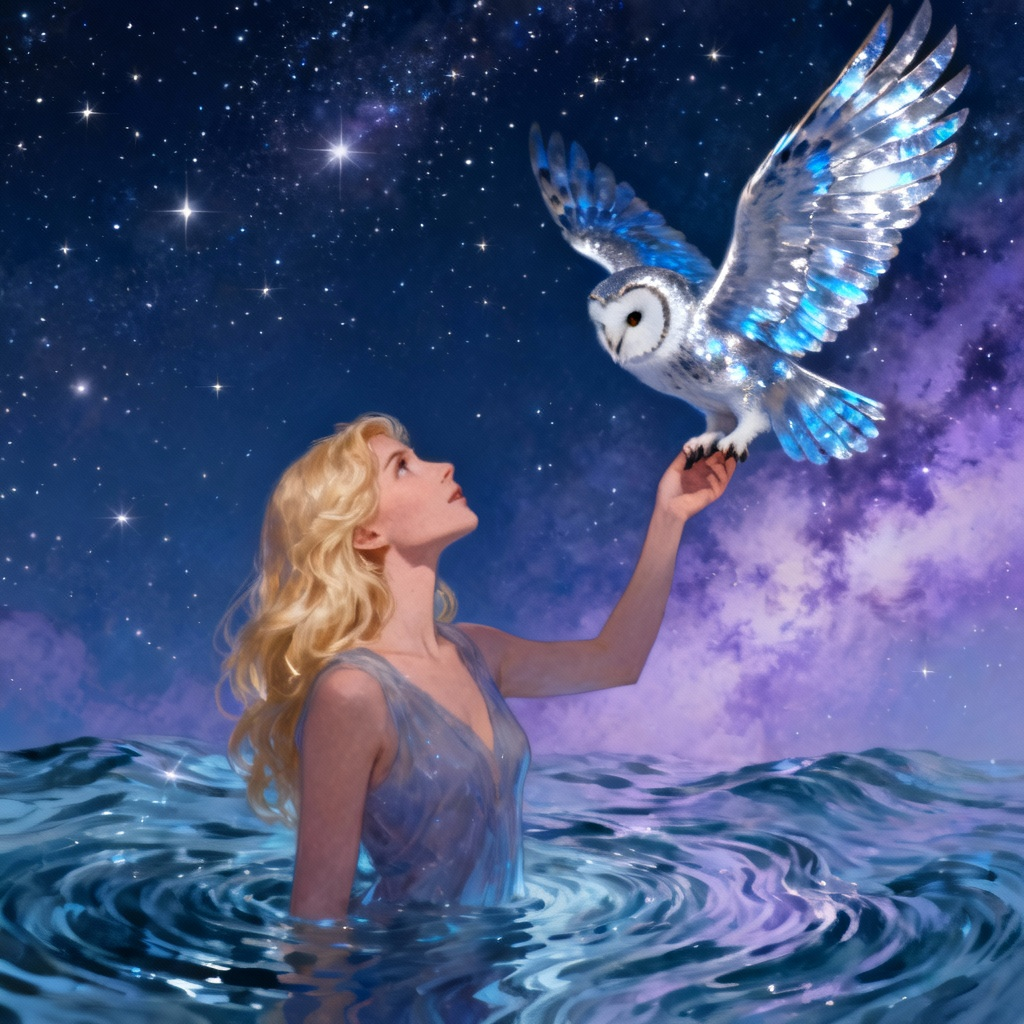
What Animal is an Aquarius? An Introduction
Google auto-complete loves the phrase “what animal is an Aquarius,” but the query itself is built on a category error. Tropical astrology assigns Aquarius to the Air element and pictures a human water-bearer, not a creature with fur or fins. Still, the human mind thinks in analogies; we instinctively ask “If Leo is a lion, what is Aquarius?” The short answer is that no single species is canonically linked to the sign, yet a cluster of animals—dolphins, otters, cranes, even the platypus—keep surfacing in pop-culture lists because they embody Aquarian keywords: inventive, social, unpredictable, and slightly detached. This article will treat “animal” as a symbolic language rather than a taxonomic box, tracing how that language evolved from Mesopotamian myth to Instagram memes.
What Animal is an Aquarius? Mythological Origins
The constellation’s oldest story is Babylonian: the god Ea, who poured life-giving water from a vase and was sometimes accompanied by a goat-fish hybrid. When the Greeks re-branded the star group as Ganymede, the cup-bearing youth, the animal layer vanished; Ganymede’s myth centers on divine kidnapping, not fauna. Yet mythographers like Hyginus (Fabulae 224) still hint at an eagle—the bird that ferried the boy to Olympus—creating an early, if indirect, avian association. Consequently, modern spiritual blogs often tag the eagle or the phoenix as Aquarius’s “mythic animal” because both symbolize perspective from altitude, mirroring the sign’s aerial detachment. Thus, while no creature sits in the constellation itself, the narrative margins provide wings.
The Symbolic Animal of Aquarius in Astrology
Traditional astrologers rarely assign animals to Air signs; symbols for Gemini and Libra are human artifacts (twins, scales) for a reason—Air governs intellect, language, and social constructs. Aquarius, ruled by Saturn in classical doctrine and by Uranus since 1781, crystallizes this abstraction: its glyph ♒ shows water waves, but they represent cosmic electricity, not literal liquid. Contemporary psychological astrologers such as Liz Greene nevertheless borrow from Jung’s “collective animal” vocabulary, describing Aquarian consciousness as “dolphin mind”: playful, echolocating patterns in the collective field, leaping above consensus reality only to dive back with unexpected solutions. The image is metaphorical, yet it sticks because it captures the sign’s blend of sociability and sudden revelation.
Aquarius and Its Animal Associations: Cultural Perspectives
Cross-cultural star lore fills the Aquarian zone with creatures that Babylon never imagined. In Chinese uranography, the “Emptiness” lunar mansion (Xu) overlaps part of Aquarius and is linked to the black tortoise of the north—an aquatic yet armored animal that mirrors Aquarian reserve. Mayan astronomers placed the bat god Camazotz near corresponding ecliptic degrees; bats, like Aquarians, navigate by sonar-like innovation and prefer nocturnal social networks. Meanwhile, Celtic druids reputedly assigned the crane, a bird noted for complex dances and communal “courts,” to the January-February gap. None of these identifications claim astrological authority today, but they reveal a global intuition: wherever water, air and electricity intersect, an unusual animal stands guard.
What Animal Represents Aquarius? Common Misconceptions
Type “spirit animal for Aquarius” into Pinterest and you’ll see pastel dolphins wearing crystal crowns—cute, but astrologically sloppy. The first misconception is conflating “spirit animal” (a New Age borrowing from Indigenous traditions) with zodiac symbolism. The second is cherry-picking traits: dolphins are communal, Aquarians are humanitarian; therefore dolphin equals Aquarius. By that logic, ants could just as easily qualify. NASA’s official constellation materials list no animal for Aquarius, and the International Astronomical Union’s 1922 boundary report sticks to star coordinates, not fauna. In short, no scientific or classical astrological text sanctions an official species; any claim beyond metaphor is branding, not scholarship.
Aquarius Zodiac Sign: Animal Symbolism Explained
If we treat animals as archetypal verbs rather than nouns, Aquarius aligns with “to echolocate,” “to migrate in flocks,” and “to molt.” Birds regenerate feathers, snakes shed skins, and both processes echo Aquarian reinvention. Astrologer Austin Coppock titles Aquarius “The Tower” in his book 36 Faces, noting that fixed-air is a container continually struck by lightning; the animal correlate is the lightning-whelk, a sea snail whose shell spirals in the opposite direction—left-handed, counter-cultural, electric. Thus, Aquarian “animals” are best understood as processes of mutation and signal transmission, not cuddly mascots. They remind us that evolution itself is the Water Bearer’s true creature, forever pouring new forms into old vessels.
The Spirit Animal for Aquarius Individuals
Within shamanic pop culture, an individual’s “spirit animal” is discovered via meditation, not sun sign. Still, polls on forums like Reddit’s r/astrology show Aquarian natives most often self-report the owl, dolphin, or snow leopard as personal guides. The common thread is cognitive specialization: owls see in darkness, dolphins decode acoustic holograms, snow leopards map vast alpine ranges with minimal energy—mirroring Aquarian talent for systems thinking. Practitioners caution against zodiac stereotyping; a Pisces can have an owl and an Aquarius a bear. Yet if an Aquarian seeks a contemplative anchor, visualizing the dolphin’s lateral sleep (one brain hemisphere awake) can dramatize the sign’s ability to stay alert within collective dreams.
Aquarius in Animal Symbolism: Dolphins and Birds
Dolphins and Aquarius share the rare combination of high encephalization and non-territorial social structure. Research published in Nature Ecology & Evolution (2017) shows bottlenose dolphins form multi-level alliances strikingly similar to human social networks—an Aquarian blueprint. Among birds, the albatross embodies Aquarian themes: it spends years in dynamic soaring flight, circumnavigating Antarctica while barely flapping, a living metaphor for detached perseverance. Ornithologists estimate that an adult wandering albatross covers 3.7 million miles in its lifetime, mirroring Aquarius’s need for panoramic perspective. Consequently, modern tarot decks such as The Light Seer’s Tarot illustrate the Aquarius card with an albatross skimming an electric-blue ocean, fusing air and water in one image.
What Animal is an Aquarius? Debunking Myths
Myth #1: “The owl is the official Aquarius animal.” Fact: no astrological association, classical or modern, confers official status. Myth #2: “Aquarius is an air sign, so its animal must fly.” Counter-example: the platypus is flightless, electro-receptive, and semi-aquatic—traits that arguably fit Aquarius better than any bird. Myth #3: “Your spirit animal matches your sun sign.” Indigenous scholars such as Dr. Kim TallBear stress that spirit relationships are land-based and ceremonial, not determined by Western horoscopes. Debunking these narratives does not kill the metaphor; it simply returns animals to their ecosystems and astrology to its symbolic domain, reminding enthusiasts that metaphor is poetry, not policy.
Aquarius and the Water Bearer: Beyond Animal Symbols
Ultimately, the Water Bearer is already a liminal being—neither god nor mortal, neither fully air nor water. Assigning an animal risks collapsing that liminality into a fixed caricature. Medieval mystic Meister Eckhart wrote, “The soul must become as a broken vessel through which eternity flows.” Aquarius embodies this cracked jar, perpetually pouring forth future possibilities. To squeeze the sign into a single species is to cork the vessel. Instead, we might adopt a process philosophy: every Aquarian moment—whether in a lab, a protest march, or a meme feed—is the animal, the water, and the act of pouring, all at once. In that sense, the most authentic Aquarian creature is the flow itself.
Comparing Aquarius Animal Symbols with Other Zodiac Signs
Where Leo proudly advertises its lion and Taurus its bull, Aquarius offers a kaleidoscope of candidates, highlighting a semiotic asymmetry within the zodiac. Fire and Earth signs gravitate toward megafauna with clear territorial profiles—Aries’ ram, Capricorn’s goat—reinforcing their cardinal or fixed modality. Air signs, by contrast, favor tools or human figures: Gemini’s twins, Libra’s scales, Aquarius’ water vessel. This pattern suggests that Air consciousness identifies with artifacts that extend mind rather than muscle. When modern astrologers import animals into Aquarius, they unconsciously restore a missing limb to the elemental family, attempting to make the sign as “instinctive” as its zodiac neighbors. The exercise reveals more about our need for narrative balance than about Aquarius itself.
Aquarius Personality Traits and Animal Analogies
Psychologists map Aquarian traits—openness, low neuroticism, high abstraction—onto the “investigative” Holland code. Ethologists find parallel profiles in corvids: crows score high on novel-object tests and show little stress in unfamiliar settings, aligning with Aquarian equanimity. Conversely, wolf packs operate on strict hierarchy, clashing with Aquarian egalitarianism; hence wolves rarely appear in Aquarian memes despite their popularity elsewhere. A 2021 Cambridge study on animal personality concluded that octopuses display the strongest “innovation-independent” trait cluster, making them the closest marine match to Aquarian cognition. Thus, animal analogies work best when they emphasize cognitive style over visual cliché, reminding us that the Water Bearer’s kingdom is the neural net, not the food chain.
What Animal is an Aquarius? Historical Context
Before Greek codification, Babylonian tablets (VAT 7847, ca. 700 BCE) list the “Aquarius” sector as GU.LA (“The Great One”) and depict it attended by a composite creature: the head of a man, body of a fish, tail of a bird—effectively a proto-mermaid. This tri-species hybrid underscores that the region’s cosmology never demanded a single mascot. By the Hellenistic era, the human figure of Ganymede eclipsed the hybrid, reflecting Greek anthropocentrism. Fast-forward to 19th-century England, when the Theosophical Society began blending Eastern and Western esoterica; they reintroduced the elephant as Aquarius’s “hidden guardian,” citing Jataka tales of the white elephant that descends from the sky to herald spiritual epochs. The historical record, then, is less a missing puzzle piece than a palimpsest of shifting totems.
The Animal Guide for Aquarius in Modern Spirituality
Contemporary practitioners often merge astrology with neo-shamanic journeying, asking “Which animal volunteers to guide my Aquarian mission?” The protocol is experiential: drumming track, intention to meet a guardian, and openness to unexpected forms. Blogs on sites like Gaia.com report that many Aquarians encounter the axolotl—a salamander that regenerates entire limb segments—mirroring the sign’s association with futuristic biotechnology. Others meet the lyrebird, famed for sampling chainsaw noises and camera shutters, echoing Aquarian media remix culture. Ethical teachers stress reciprocity: if the axolotl appears, support wild-habitat NGOs in Mexico rather than buying a pet. In this framework, the animal is not a mascot but a contractual ally, co-creating the Water Bearer’s next pour.
Aquarius in Animal Totems: A Practical Guide
To integrate an Aquarian totem without cultural appropriation, start with observation, not invocation. Keep a moon journal for one lunar cycle, noting which species repeatedly enter your field—via news, dreams, or city wildlife. Cross-reference those animals with peer-reviewed studies on their behavior; science grounds the symbol in reality. Next, translate observed traits into actionable ethics: if the urban crow keeps showing up, emulate its tool-use by upcycling tech waste—an Aquarian specialty. Finally, offer reciprocity: donate to a corvid sanctuary or install a bird bath. The goal is not to “be” the animal but to let its ecological strategy inform your humanitarian project, turning the ancient water bearer into a modern ecosystem engineer—one pour, one planet, one future at a time.