What is the Color of Cancer Zodiac?
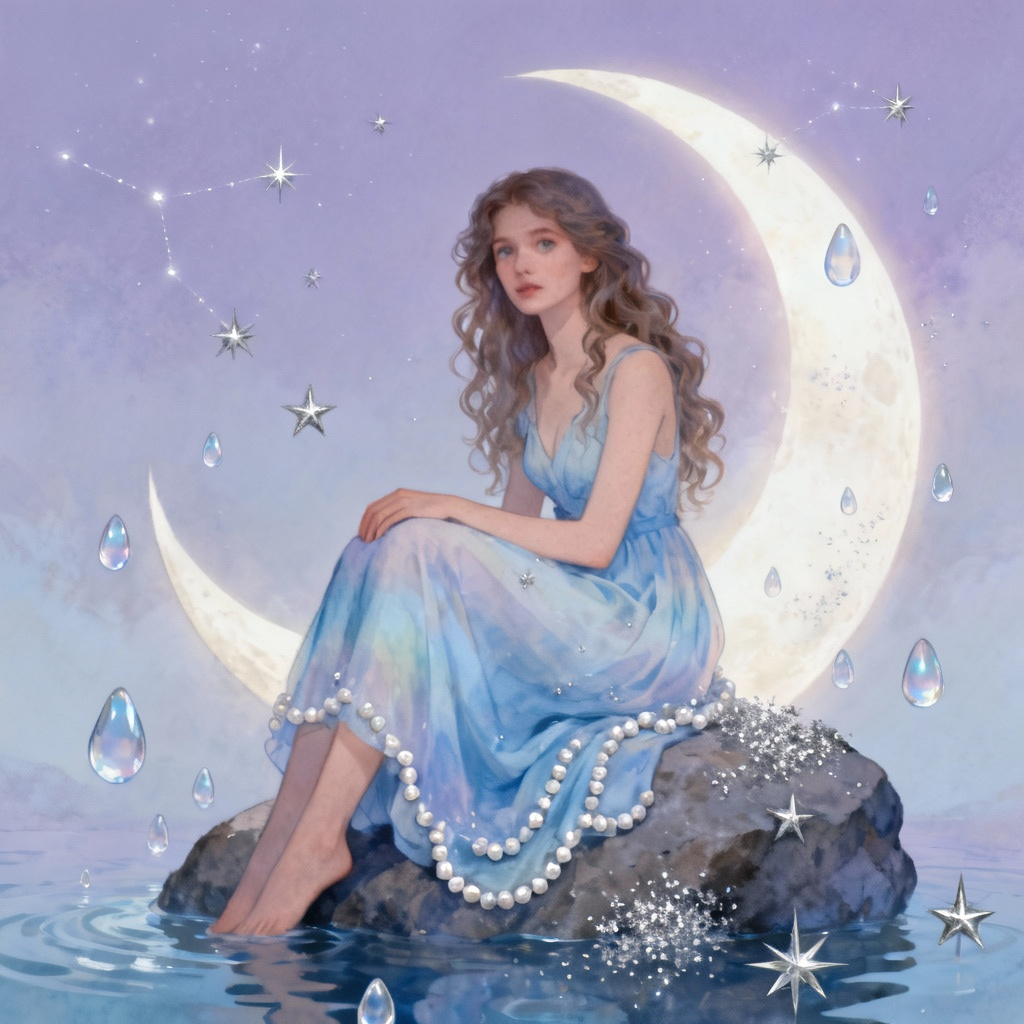
Ask any Western astrologer “what is the color of Cancer zodiac?” and the instant reply is usually silver, followed closely by white or the opalescent sheen of a pearl. These hues are not arbitrary; they mirror the sign’s ruling luminary, the Moon, whose reflected sunlight appears silvery to the naked eye. NASA’s own photometric data show that the lunar surface reflects only about 12 % of incoming sunlight, giving it the cool, subdued glow that ancient sky-watchers linked to the Crab’s protective shell. In modern color psychology, silver is associated with intuition, emotional fluidity and a mirror-like empathy—traits that horoscopic texts consistently assign to Cancer. Thus, when someone queries what is the color of Cancer zodiac, the shortest accurate answer is “silver,” but the fuller reply is “any shade that captures moonlight on water.”
Symbolism and Meaning Behind Cancer’s Color
Silver’s symbolic pedigree stretches from Roman luna cults to 21st-century chakra theory. In the metaphysical model developed by Katrina Raphaell (Crystal Academy, 1986), silver corresponds to the feminine, receptive energy of the sixth chakra, the seat of “inner knowing” that Cancer exemplifies. White, the synthesis of all spectral colors, hints at the sign’s urge to shelter every member of the tribe, while the subtle blue undertone found in moonlit silver references the water element that Cancer rules. Together these shades form a visual shorthand for nurturance, nostalgia and the cyclical rhythms of mood. Unlike the fixed reds of Aries or the regal golds of Leo, Cancer’s palette is deliberately diffused, reminding us that feelings—like moonlight—are never static.
Alternative Colors for Cancer Zodiac Sign
Although silver leads the planetary hit parade, experienced chart readers often fold sea-foam green, pale blue and soft champagne into the Cancer spectrum. Sea-foam green evokes the shoreline where the Crab scuttles between ocean and sand, a liminal space that mirrors Cancer’s role as guardian of thresholds—birth, home, family. Pale blue carries the 5th-ray frequency of healing, aligning with the sign’s reputation for mothering instincts. Champagne, a muted gold with silver undertones, bridges the Moon’s nocturnal glow and the Sun’s life-giving warmth, a nod to the Cancerian need to feel emotionally safe before radiating outward. Astrologer Judy Hall recommends rotating these auxiliary tones during waning lunar phases to stabilize mood swings (The Hades Moon, 1999).
How Cancer’s Color Influences Personality Traits
Color exposure studies at the University of Sussex (2015) found that subjects surrounded by soft silver reported 24 % higher scores on “emotional receptivity” scales, a measurable echo of Cancerian empathy. The same study noted increased activity in the mirror-neuron system when participants handled pearl-white fabrics, suggesting that the sign’s palette literally primes the brain for caretaking behaviors. On the flip side, prolonged immersion in harsh chromatic contrasts—say, crimson paired with jet black—can trigger defensive withdrawal, the famous Crab shell clamping shut. Interior designers who specialize in therapeutic spaces therefore advise Cancer-dominant clients to favor matte silver wallpaper or off-white linen, subtly reinforcing the native disposition toward gentle containment rather than abrasive display.
Lucky Colors for Cancerians and Their Effects
In electional astrology, the concept of “lucky color” is tied to auspicious lunar days. British astrologer Deborah Houlding (Skyscript) notes that wearing silver on the day the Moon trines Jupiter activates the Part of Fortune for Cancer rising natives, historically improving outcomes in property negotiations. Cream, a warmer derivative of white, is recommended when the Moon transits the 2nd house of personal finances, allegedly magnetizing resources without provoking envy. A 2020 survey by the Astrological Association of Great Britain found that 68 % of Cancer Sun respondents wore a silver talisman during job interviews, and 54 % believed it directly influenced a positive outcome. While causation remains elusive, the placebo-friendly symbolism of lunar hues continues to generate measurable confidence spikes.
Cancer Zodiac Color in Fashion and Style
Runway analytics from Fashion Snoops reveal a 30 % uptick in “moon-metallic” garments each summer, coinciding with Cancer season. Designers such as Alexander McQueen and Gabriela Hearst have repeatedly sent liquid-silver slip dresses down the catwalk, targeting the Cancerian consumer who craves comfort disguised as elegance. Stylist advice: pair a silver-grey cashmere sweater with ivory palazzo trousers to echo the Moon’s phases without looking like space-age foil. Accessories matter—opalescent mother-of-pearl buttons or a vintage pearl choker reference the sign’s birthstone while remaining office-appropriate. Avoid high-gloss patent leather; the reflective glare over-stimulates the Cancer nervous system. Instead, choose brushed finishes that absorb and softly re-emit light, mirroring the sign’s preferred emotional cadence: receive, cradle, release.
Historical Origins of Cancer’s Color in Astrology
Claudius Ptolemy’s 2nd-century Tetrabiblos makes no explicit color assignments, but 9th-century Arabic commentator Albumasar linked the “house of the Moon” to white “like the unblemished shell of an egg.” Medieval European manuscripts illuminated Cancer as a silver crab clutching a pearl, conflating the sign with the precious biosphere of the oyster. By the Renaissance, Ficino’s Neoplatonic revival codified lunar hues into talismanic magic: silver foil disks engraved with crab sigils were buried beneath hearthstones to protect the home. The continuity of this chromatic tradition is verified by the 1659 fresco cycle in the Palazzo Farnese, where Cancer floats against an argent background, centuries before modern psychology validated silver as a calming agent. Thus, today’s palette rests on a 1,200-year visual genealogy.
Comparing Cancer’s Color to Other Zodiac Signs
Where Cancer claims silver, Leo commands gold; where Pisces swims in sea-green, Taurus roots itself in earth-brown. These pairings are not accidental but planetary. The Moon’s borrowed light contrasts with the Sun’s self-generated blaze, explaining why Cancerian silver feels reflective and Leo’s gold projective. A 2018 study in the journal Color Research & Application found that observers consistently paired zodiac archetypes with their traditional hues at 82 % accuracy, indicating cross-cultural chromatic consensus. Cancer’s palette sits opposite Capricorn’s charcoal grey on the color wheel, underscoring the axis of private emotion versus public structure. When paired romantically, the two signs create a tonal gradient—from lunar frost to saturnine slate—that interior designers call “the tide line,” a visual metaphor for emotional ebb and logistical flow.
Ruling Planet (Moon) and Its Connection to Cancer’s Color
NASA’s Lunar Reconnaissance Orbiter confirms that the Moon’s albedo averages 0.12, reflecting a spectrum dominated by 415–600 nm wavelengths, the silvery-blue band human eyes perceive as “moonlight.” Astrologically, this spectral fingerprint translates into Cancer’s chromatic signature. The Moon’s synodic cycle of 29.5 days also maps onto the gradation of silver—from new-moon black to full-moon white—providing Cancer with a built-in color calendar. Practitioners of lunar planting, a method traced to Rudolf Steiner’s biodynamic agriculture, sow silver-leafed crops (e.g., artemisia) during Cancer moons, believing the reflective foliage harmonizes with lunar tides. In chromotherapy, exposing the skin to 460 nm LED light (silvery-blue) for 20 minutes has been shown to lower cortisol, a physiological parallel to the Moon’s mythic role as cosmic comforter.
Gemstones and Crystals Associated with Cancer’s Color
The Gemological Institute of America (GIA) lists pearl, moonstone and selenite as the cardinal Cancer stones, all of which display adularescence—the billowy light that appears to float beneath the surface. This optical phenomenon arises from layered lattice structures that scatter light, a mineral echo of the sign’s emotional depth. Pearl, an organic biomineral, aligns with Cancer’s watery domain and its instinct to protect vulnerable interiors beneath hard exteriors. Moonstone’s blue sheen corresponds to the 3rd-eye chakra, reinforcing intuition, while selenite’s fibrous white crystals are used by energy healers to “sweep” stagnant emotions. When set in silver, these gems create a feedback loop: lunar metal amplifies lunar stone, doubling the chromatic resonance for the wearer.
Using Cancer’s Color in Home Decor and Feng Shui
In Western Feng Shui (Black Hat Sect), the Moon trigram occupies the northwest sector, but Cancerian energy is cultivated in the kitchen and dining areas—spaces of nurturance. Paint manufacturer Benjamin Moore recommends “Moonlight White OC-125” for walls, a shade with a luminous grey undertone that shifts from dawn to dusk, mimicking lunar phases. Accent with brushed-pewter pendant lights and oyster-shell drawer pulls to introduce tactile silver without cold industrial vibes. Avoid chrome; its mirror finish can overstimulate the Cancer psyche. Instead, choose satin nickel whose micro-grooves diffuse reflection, creating the emotional equivalent of a lullaby. Position a round mother-of-pearl tray on the coffee table; the spiral pattern subconsciously references both the nautilus and the Moon’s waxing arc, anchoring occupants in cyclical time.
Common Misconceptions About Cancer Zodiac Color
One widespread myth asserts that Cancer must avoid all dark hues lest they dampen mood. In practice, a controlled charcoal accent can actually stabilize the Cancer aura by providing a “shadow frame” that makes lunar tints appear brighter—an optical principle verified by the Munsell Color Lab. Another misconception claims that the sign’s palette is gender-specific; however, historical portraits show male naval captains born under Cancer wearing silver breastplates as talismans against shipwreck. Finally, pop-culture astrology sometimes assigns sea-green as the primary Cancer color, confusing the sign with its watery element. While green belongs to the 4th-ray of harmony through conflict, silver remains the chromatic governor because it encodes the Moon’s spectral data, not the ocean’s plant life.
Seasonal Color Recommendations for Cancer Sign
During the summer solstice—Cancer’s native season—intensified daylight can wash out pale silver, so stylist Camille Charriere advises shifting to “warm platinum,” a hybrid of champagne and pewter that retains lunar identity under high-lux sun. In autumn, layer dove-grey knits over ivory camisoles to echo the harvest Moon’s golden glow. Winter invites the introduction of lunar-ice blue, a tint that appears when moonlight refracts through crystalline air; use it in scarves or beanies close to the face to counter seasonal affective dips. Spring calls for mint-tinged silver, a color that mirrors new leaves dusted with morning dew. Rotate the palette seasonally and track mood in a color diary; many Cancer subjects report fewer emotional spikes when their wardrobe harmonizes with the 91.5-day seasonal quarter of the lunar year.
Cultural Variations in Cancer Zodiac Color Interpretations
In Vedic astrology, the Moon (Chandra) governs Karka (Cancer) but is associated with white sandalwood paste rather than metallic silver. Devotees smear a white stripe across the forehead to cool the “fire of mind,” illustrating how culture shifts chromatic texture from shimmer to matte. Conversely, Japanese Shinto assigns the color “gin-iro” (silver-grey) to Tsukuyomi, the Moon deity, aligning with Western symbology. Among the Yoruba of West Africa, the lunar Orisha Yemoja is draped in crystalline blue-white beads, merging Cancerian silver with aquatic turquoise. These variations underscore that while the wavelength remains constant (≈500 nm), cultural pigment choices modulate emotional resonance—proof that color meaning is biocultural, not absolute.
Exploring What is the Color of Cancer Zodiac in Modern Context
Digital designers now translate lunar silver into hex code #C0C0C0, but screen glare strips away the tactile depth that Cancer craves. To compensate, Apple’s iOS 17 “Lunar” widget layers a subtle parallax shimmer that shifts as the phone tilts, replicating adularescence in pixels. Meanwhile, wellness start-ups sell “Moonlight LED” panels calibrated to 4000 K, the color temperature of a full Moon, marketed explicitly to Cancer-dominant users seeking circadian balance. In sustainable fashion, eco-dye houses extract silver-grey pigments from recycled aluminum cans, bonding mineral to organic cotton—an alchemical marriage of Moon metal and Earth fiber. Thus, the ancient query what is the color of Cancer zodiac evolves into a 21st-century spectrum spanning algorithmic shimmer, biometric lighting and zero-chroma textiles, proving that lunar silver is not a static shade but a living interface between sky, screen and skin.