Introduction to Aquarius Constellation: Basics for Beginners
Aquarius, Latin for “water-bearer,” is the 10th-largest constellation in the sky and one of the 12 zodiacal figures. Despite its size, it has no first-magnitude stars, so beginners often overlook it. The constellation straddles the celestial equator, making it visible from virtually every inhabited latitude (peak visibility between +65° and –90°). Its brightest star, Sadalsuud (β Aquarii), shines at magnitude 2.87, while Sadalmelik (α Aquarii) is a close second. Aquarius is bordered by Pisces to the north-east, Capricornus to the south-west, and Pegasus to the north-west. Knowing these neighbors is the first step in learning how to find Aquarius constellation with confidence.
Best Times of Year to Spot Aquarius: Seasonal Visibility Guide
The Water Bearer is best seen from early September through January, with highest culmination around 10 p.m. local time in late October. During these months the constellation rides high above the southern horizon for northern-hemisphere observers, and high in the north for southern-hemisphere viewers. By February it begins to sink into evening twilight, so plan autumn or early-winter sessions. Dark-sky calendars such as TimeandDate.com list monthly altitude graphs; use them to pick nights when Aquarius will climb at least 30° above haze. Remember that the new-moon week within this window offers the darkest skies, dramatically improving your odds of identifying faint asterisms inside Aquarius.
Using Neighboring Constellions to Locate Aquarius
Think of Aquarius as the missing puzzle piece between three easy-to-spot patterns. Start with the Great Square of Pegasus: draw an imaginary line from Alpheratz through Markab and extend it 25° south-west until you hit a pair of 3rd-magnitude stars, Sadalsuud and Sadalmelik—those are Aquarius’s “shoulders.” Alternatively, locate bright Fomalhaut in Piscis Austrinus; 15° north lies the Water Bearer’s “water jar” asterism (γ, π, ζ, η Aqr). If you can identify the ring of Pisces to the east, simply slide westward along the ecliptic until the distinctive Y-shaped jar appears. Using these stepping-stones turns the abstract question of how to find Aquarius constellation into a connect-the-dots exercise.
How to Find Aquarius Constellation with a Star Chart
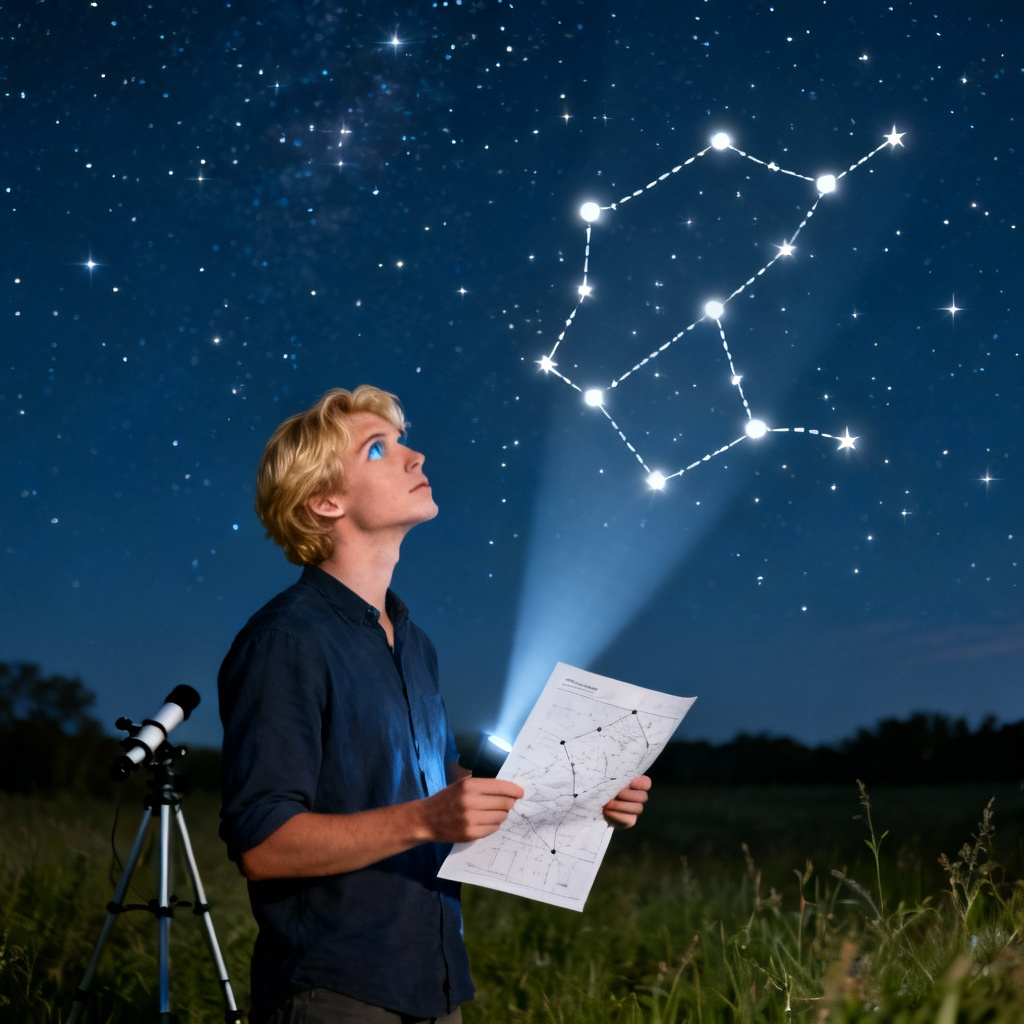
A printed or app-based star chart is the most reliable analog tool. Set the chart for 10 p.m. at mid-October, face south, and hold the map overhead with the southern horizon at the bottom. Locate the ecliptic—the dotted line labeled with zodiac names—and trace it through Capricornus into Aquarius. Circle the “water jar” (asterism of four stars forming a crooked Y) because it is the brightest sub-region. Rotate the chart until the orientation matches the sky; red-filtered flashlights preserve night vision while you compare chart to heaven. Within 5–10 minutes your eyes will pick out the faint but unmistakable outline, answering the core question of how to find Aquarius constellation without electronics.
Key Stars and Patterns in Aquarius for Easy Identification
Instead of hunting the entire constellation, memorize three internal signposts. First, the Water Jar: γ Aqr (Sadachbia), π Aqr, ζ Aqr, and η Aqr form a 4°-wide Y reminiscent of a miniature Big Dipper. Second, look 8° east for the “stick figure” of two parallel lines—ι and λ Aqr—representing the water stream pouring southward toward Fomalhaut. Third, identify the bright pair Sadalsuud and Sadalmelik 12° north of the jar; they act as the Bearer’s head and shoulders. Once these three elements lock into place, the remaining faint stars naturally fill the outline, turning a vague stellar scatter into the recognizable Water Bearer.
Using Astronomy Apps and Tools to Find Aquarius
Modern planetarium apps remove guesswork. In SkySafari, Stellarium Mobile, or Sky Guide, type “Aquarius” and enable compass mode; the app overlays an arrow on the live sky view. Activate the night-vision red overlay to protect adaptation. For astrophotographers, PhotoPills’ augmented-reality mode plots the constellation against your DSLR frame, handy for framing the 2025 Saturn-Aquarius conjunction. Remember to calibrate your phone’s gyroscope by waving it in a figure-eight pattern; inaccurate sensors are the leading cause of “missing” the constellation even when it is in plain sight. Offline mode conserves battery during long sessions under cold autumn skies.
Step-by-Step Guide to Observing Aquarius with Binoculars
10×50 binoculars reveal Aquarius’s hidden treasures: the globular cluster M2 (magnitude 6.3) and the planetary nebula NGC 7009 (Saturn Nebula, magnitude 8.0). Step 1: center Sadalmelik in your field. Step 2: slew 5° north to nab M2—look for a fuzzy snowball distinct from surrounding stars. Step 3: return to the Water Jar and slide 2° south-east to land on NGC 7009; at 150× in a telescope it shows its namesake ansae. Step 4: sweep along the “water stream” to catch the wide double 94 Aqr (separation 12″). Recording these treats in a notebook transforms a simple target hunt into a rewarding deep-sky tour.
Common Challenges and Mistakes When Finding Aquarius
Light pollution is the primary culprit; Aquarius’s brightest star is <3 mag, so suburban skies reduce the pattern to three or four stars. Many beginners also confuse the Great Square of Pegasus with the Water Jar—both are quadrilaterals, but the Jar is smaller and tilted 45°. A classic error is observing too early in summer when Aquarius skims the horizon. Finally, neglecting dark adaptation: looking at a phone screen even briefly resets rhodopsin levels, erasing faint stars for 20 minutes. Combat these issues by driving to a Bortle-4 or darker site, using red film on flashlights, and verifying star colors (Aquarius stars are white, not the blue-white of Pegasus).
How to Find Aquarius Constellation in Urban vs. Rural Settings
In cities, rely on “anchor” stars and restrict views to the water jar. Stand in a shadowed alley blocking direct streetlights; apps like Clear Outside give transparency forecasts—wait for humidity <60 %. Once you spot the Y-shape, mentally extend lines to fainter members even if only two appear; urban 50 mm binoculars will pull in the rest. Rural observers can trace the full 35° outline, photograph the Milky Way background, and chase M72 and the Helix Nebula (NGC 7293) with a 100 mm refractor. Regardless of locale, the principle remains identical: identify the jar first, then expand outward—proving that learning how to find Aquarius constellation is scaleable to any sky quality.
Timing and Conditions: Best Night Hours for Viewing Aquarius
Altitude matters more than clock time. Aim for the window when Aquarius climbs >30° above the horizon, the zone where atmospheric extinction drops below 0.3 magnitudes. For latitude 40° N this occurs between 9 p.m. and 2 a.m. from mid-October to early November. Check your personal “culmination time” with the free service Heavens-Above: enter location, select “Aquarius,” and note the transit column. Avoid nights with >70 % humidity or jet-stream winds >25 m s⁻¹; both scatter light and smear faint stars. A transparent, moonless sky can boost limiting magnitude by a full class, turning the Water Bearer from elusive to obvious.
Mythological Background of Aquarius: Enhancing Your Search
Greek tradition casts Aquarius as Ganymede, the cupbearer to the gods; his poured water forms the adjacent “water stream” of faint stars ending at Fomalhaut. Babylonians saw the figure as the god Ea, associated with ritual purification jars. Knowing the narrative helps memory: imagine the Jar tilting toward the southern fish (Piscis Austrinus) every autumn, a celestial reminder of irrigation and the coming rainy season. Storytelling also aids star-hopping—when you recognize the “stream,” you instantly know which direction to sweep for the next asterism. Myth thus converts an abstract coordinate set into a meaningful picture anchored in human culture.
How to Find Aquarius Constellation During Celestial Events
Mark your calendar for 6 October 2025, when the waning crescent Moon occults δ Aquarii for observers in Hawaii and the central Pacific. Such events give you a GPS-level fix: if you can see the Moon, Aquarius is immediately adjacent. The Eta Aquariid meteor shower (peaks 5–6 May) radiates from near the Water Jar; although the constellation rises just before dawn for northern observers, the radiant’s position is an arrow pointing directly to the Jar. In late 2024 Saturn cruises through Aquarius, appearing at magnitude 0.8—use the planet as a bright guidepost, then explore nearby M2 and NGC 7009 once you’ve mastered how to find Aquarius constellation via the wandering planet.
Comparing Aquarius to Other Zodiac Constellations for Accuracy
Because Aquarius lies on the ecliptic, it is easy to confuse with neighboring zodiac figures. Capricornus to its west is smaller and shaped like a narrowing boat, whereas Aquarius fans out across 20° more sky. Pisces to its east displays the prominent “circlet” asterism, absent in Aquarius. Scorpius and Leo have bright red giants; Aquarius lacks any star >2.9 mag, so if you see a ruddy beacon you’re in the wrong constellation. Use the “magnitude ladder” test: if you can detect stars at the limit of 4.5 mag, you are probably in Aquarius; if 3 mag stars are hard, you may be lost in Pisces. Such comparisons sharpen accuracy and prevent circular star-hopping errors.
Historical Methods for Locating Aquarius: Past to Present
Before printed atlases, Islamic astronomers used “asterism clocks”: they noted when the Water Jar reached 15° above the horizon, signaling the start of the autumn irrigation season. Polynesian navigators instead relied on the predawn rising of the Jar, which coincided with the annual appearance of the Tahitian bonito fish. In the 17th century, Hevelius drew Aquarius on his celestial globe with exaggerated stream lines, helping observers trace faint stars. Today, digital setting circles and GoTo mounts store the J2000 coordinates (RA 22h 20m, Dec –10°) to sub-arc-minute precision, yet the underlying star patterns remain unchanged—proof that mastering how to find Aquarius constellation links modern amateurs to centuries of sky watchers.
How to Find Aquarius Constellation: A Comprehensive Step-by-Step Tutorial
1) Determine your local midnight culmination date (late October). 2) Check weather: transparency >3/5, cloud cover <20 %. 3) Print or download a star chart set for 10 p.m. local time. 4) Dark-adapt for 20 minutes; no white light. 5) Face south, locate the Great Square of Pegasus, and drop 25° south-west to Sadalsuud. 6) Identify the Y-shaped Water Jar 5° south. 7) Use binoculars to confirm M2 just north of Sadalmelik. 8) Trace the water stream to Fomalhaut to lock the overall outline. 9) Log observations: note seeing, limiting magnitude, and equipment used. 10) Repeat on successive nights to refine your mental map. Follow these ten steps and you will never again wonder how to find Aquarius constellation; the Water Bearer will become as familiar as Orion in your personal sky repertoire.